Effective plant tissue culture requires understanding how cells communicate, coordinate, and reprogram in situ—not merely adjusting external hormone concentrations.
Plant tissue culture has become an essential component of modern plant biotechnology and the bioeconomy, with micropropagation representing one of its most widely applied commercial technologies. Despite its long history, the field still relies heavily on generalized protocols developed decades ago, most notably the Skoog–Miller concept of exogenous hormonal balance and the Murashige–Skoog culture medium. While these tools were transformative at the time, their applicability is inherently limited and strongly species- and context-dependent.
Many plant species are commonly described as recalcitrant in tissue culture. From a biological perspective, however, recalcitrance does not represent an intrinsic inability to regenerate, but rather a failure to meet the minimal developmental and physiological requirements of the tissue under in vitro conditions. When culture systems do not reflect the endogenous regulatory logic of the plant, regeneration efficiency is inevitably low.
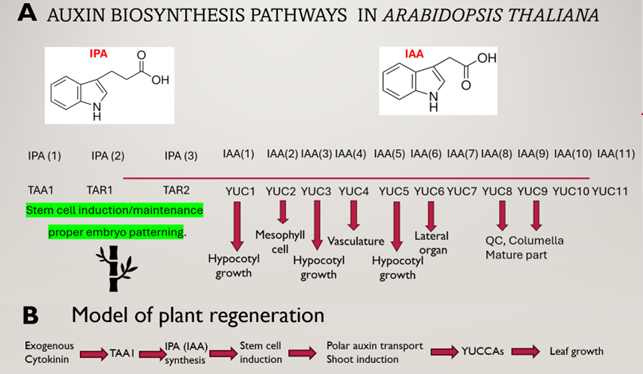
Accumulating evidence demonstrates that plant growth, morphogenesis, and regeneration are primarily regulated by local endogenous hormone synthesis, transport, and signaling, tightly coupled to cell-type–specific epigenetic states and developmental competence. Exogenous hormones do not function as true regulators; instead, they act as perturbations that may trigger or disrupt endogenous regulatory circuits depending on timing, dose, and tissue context. When applied without biological justification, they often mask underlying mechanisms and lead to inconsistent outcomes.
Our approach moves beyond historical dogma toward data-driven, species-specific optimization of plant tissue culture systems. We focus on understanding and modulating endogenous hormonal balance through targeted adjustment of mineral nutrition and organic medium components that influence hormone biosynthesis, distribution, and cellular responsiveness. This strategy aligns culture conditions with the intrinsic developmental programs of the plant rather than forcing artificial responses.
By integrating modern insights from plant cell biology, epigenetics, and developmental physiology, we provide practical solutions for improving callus formation, somatic embryogenesis, organogenesis, plant growth, and acclimatization. The result is more robust, reproducible, and efficient regeneration systems that reduce time, cost, and experimental uncertainty—especially for species previously considered difficult or unreliable in vitro.
Key references
- Pasternak, T., & Steinmacher, D. (2025). Plant tissue culture in vitro: A long journey with lingering challenges. International Journal of Plant Biology, 16(3), 97.
- Pasternak, T. P., & Steinmacher, D. (2024). Plant growth regulation in cell and tissue culture in vitro. Plants, 13(2), 327.
- Yaroshko, O., Pasternak, T., Larriba, E., & Pérez-Pérez, J. M. (2023). Optimization of callus induction and shoot regeneration from tomato cotyledon explants. Plants, 12(16), 2942.
- Pasternak, T., Lystvan, K., Betekhtin, A., & Hasterok, R. (2020). From single cell to plants: mesophyll protoplasts as a versatile system for investigating plant cell reprogramming. International Journal of Molecular Sciences, 21(12), 4195.
- Pasternak, T., Paponov, I. A., & Kondratenko, S. (2021). Optimizing protocols for Arabidopsis shoot and root protoplast cultivation. Plants, 10(2), 375.
- Fehér, A., Pasternak, T., Ötvös, K., & Dudits, D. (2005). Plant protoplasts: Consequences of lost cell walls. Journey of a Single Cell to a Plant; Murch, SJ, Saxena, PK, Eds.
- Feher, A., Pasternak, T. P., & Dudits, D. (2003). Transition of somatic plant cells to an embryogenic state. Plant cell, tissue and organ culture, 74(3), 201-228.
Leave a Reply